
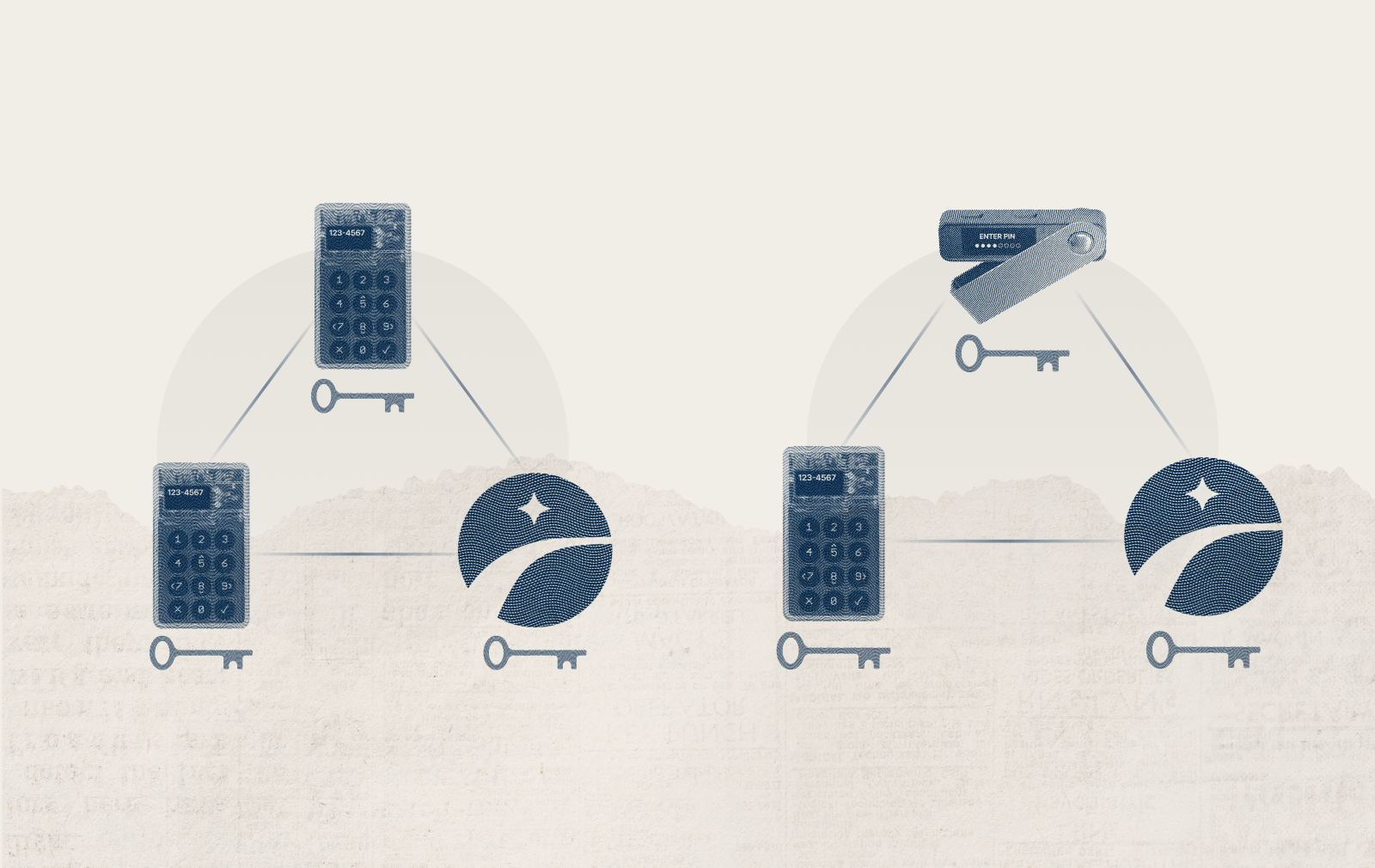
On Thursday, July 30th 2026, the company Coinkite, makers of the Coldcard hardware wallet, issued a security advisory about a vulnerability with most Coldcard devices. Unfortunately, most singlesig wallet users were immediately vulnerable to having their funds stolen. Most multisig wallet users, including Unchained clients, were not. In this article, we’ll explain the difference between these types of wallets, and how multisig demonstrated superior protection, even beyond the simple redundancy of multiple keys.
If you are an Unchained client seeking guidance about this Coldcard vulnerability, please see this article.
How the bug worked
The foundation of any bitcoin wallet is entropy, which refers to unpredictable randomness. Generating secret keys to build and control the wallet involves generating a very large, random number that other people won’t realistically be able to guess or recreate. Entropy can be created manually by rolling a sufficient quantity of dice or flipping enough coins, but cryptocurrency hardware wallets have also tried to make it easier for users by implementing RNGs (random number generators) within the device, creating a quick one-step process.
With the Coldcard incident, a serious bug was discovered with the RNG process, revealing that the entropy generated by most Coldcards over the past five years was insecure. The entropy wasn’t nearly as unpredictable or random as people believed, and the number of possible seeds and keys that could be produced was much smaller than it needed to be.
Because entropy is the foundational starting point, its lack of security means every other layer built on top of it is insecure as well. It also means that after the vulnerability was discovered, there was nothing affected users could do. The original bad entropy was used to secure their wallets, so all they could do was try to get to safety as fast as possible. Until they get to safety, attackers can exploit the vulnerability to search for private keys connected to bitcoin balances.
Why singlesig wallets were most vulnerable
A singlesig (single-signature) wallet is an approach to securing bitcoin that only requires one bitcoin private key to approve the movement of bitcoin. A single cryptographic signature from that key is sufficient. While this model is convenient for moving funds quickly and easily, it also introduces a single point of failure (SPOF). If the key is misplaced, destroyed, or stolen, the bitcoin can be gone for good.
Attackers exploiting the Coldcard vulnerability could quickly find keys protecting balances in singlesig wallets, especially those without additional protections. They began scanning the possible keys (following common derivation paths) and quickly stumbled upon keys that belonged to users securing bitcoin. As soon as they found a key that was controlling a balance, the attacker could then use the key to move the bitcoin into a wallet they alone control, stealing the bitcoin.
Why multisig wallets offered protections
A multisig (multisignature) wallet is an approach to securing bitcoin that involves multiple different keys. If you are new to multisig wallets, we invite you to review our dedicated introductory article about them.
1. Multisig wallets require a quorum of keys to spend bitcoin
Multisig wallets require a threshold of keys to move funds. The quintessential example is a wallet built with three unique keys, while signatures from any two of those keys are required to spend bitcoin—a setup known as a 2-of-3 multisig wallet. This offers substantially more protection than a singlesig wallet, because there are no single points of failure as long as each key is stored separately. If one key is misplaced or destroyed, there are still two remaining keys that can move the bitcoin. If one key is stolen (or in this case, compromised by an existential RNG bug), the thief doesn’t have enough keys to access any bitcoin.
With the Coldcard incident, any number of the three keys in a 2-of-3 multisig could have been generated by a Coldcard and impacted by the vulnerability. If zero keys or only one key was impacted, then attackers would lack enough private keys to access funds. If two or three keys were impacted, multisig users were still afforded some protections, but those require understanding how public keys are used to build bitcoin addresses.
2. All public keys are required to spend from an address
Singlesig bitcoin addresses have relatively simple construction. Each address is built with one public key. However, multisig addresses are built with multiple public keys, one for each of the total keys involved with the setup. For example, a 2-of-3 multisig address involves a total of three keys, so three public keys are used to build it.
Due to the way bitcoin transactions work, all of the public keys associated with an address must be known by someone who is spending out of that address. For a singlesig address, this isn’t relevant—you already need the controlling private key, and if you have the private key, it’s trivial to get the public key also. But for a 2-of-3 multisig address, you need the threshold of two private keys, and you also need the third remaining public key.
That final public key could be an important factor, protecting funds in the event that an attacker managed to get two private keys. In the Coldcard incident, it provided helpful protection for many multisig wallets that were built with a majority of Coldcard keys.
3. Public keys are not always public
Public keys are less sensitive than private keys, because they are generally expected to become public information at some point, whereas private keys should always be kept secret and protected. However, even though they are less sensitive, public keys aren’t published openly by default.
There are two main ways that public keys could be revealed. First, every multisig wallet has configuration information, sometimes called a configuration file or a descriptor. The configuration file doesn’t contain any private keys, but it does contain all the information needed to calculate all the public keys for any address within that wallet. This allows users to import their multisig wallet into the wallet application of their choice, rather than commit to a single wallet application. However, it’s also a best practice to keep the configuration information private, because publicizing it would reveal all your wallet balances and public keys.
Second, whenever bitcoin is spent out of a multisig address, all the public keys for that address (not the entire wallet) are published publicly, due to how bitcoin transactions function. This means that if you spend out of a multisig address, it’s best to empty the address completely, sending any change back to your wallet at a fresh, unused change address. Afterward, it’s best to avoid depositing additional bitcoin to the spent-from address. Instead, future deposits to the wallet should be made to a fresh deposit address. (When you use an Unchained vault, our platform helps you do all this by default, although it’s impossible to prevent users from manually depositing to reused addresses.)
One additional caveat is that even if an address had never been spent out of previously, when it is finally spent out of, there is a window of time before the transaction is confirmed into a block, and the transaction is considered to be in a “pending” state. If the transaction was broadcast using the typical method of public mempools, then the public keys for the address have been revealed publicly, and bitcoin could be temporarily vulnerable to theft until the transaction is confirmed. Mitigating this “RBF attack” risk involves an alternative way of broadcasting transactions—sending transactions directly to a trustworthy bitcoin miner, rather than broadcasting them to public mempools. Unchained quickly implemented this as an option for clients in response to the Coldcard incident.
4. Guessing combinations of keys is not always trivial
A 2-of-3 multisig built entirely with three Coldcard keys may seem like a dangerous situation (and indeed it could be), but even in this case multisig would provide some security benefits. If a bitcoin balance with this security arrangement wasn’t on a spent-from address, and the wallet configuration remained private, attackers would have to do substantially more work to find and access that balance.
Not only would attackers need to find all three private and public key pairs, but they would also have to associate them together properly. In other words, if an attacker produced a list of all the possible keys, they’d then have to try combinations of three until they found the three that matched your bitcoin address. Depending on the size of the list, this could increase the work required by orders of magnitude, and potentially render it unfeasible, or at least unprofitable, to attempt.
The bottom line
Multisig wallets offer a substantial security enhancement, capable of eliminating single points of failure. The Coldcard incident is an important case study that tested—and ultimately demonstrated—the advantages of multisig wallets. It’s clear at this point that multisig gave many users additional fault-tolerance and time to respond. Even if someone used multiple Coldcards for their multisig wallet keys, the situation may have felt stressful, but responding with careful, relatively quick action was highly effective at protecting funds.
Hacks often makes headlines, but the quieter risk is the one sitting in your own setup: a single key, a single location, a single point of failure that one bad day could expose. Find yours in three minutes by taking this quiz.
Multisig wallets aren’t difficult to set up, and it’s even easier with a collaborative custody partner like Unchained. In our default 2-of-3 multisig structure, you hold two keys, giving you full, exclusive, independent access. Unchained holds the third back-up key, reducing the amount of keys you need to manage yourself. We also offer direct, one-on-one education for setting up the multisig wallet properly, plus ongoing support options and inheritance services. If any of this interests you, we invite you to book a free consultation with our team to ask questions and learn if our offerings are right for you.
.png)
.png)
.png)