
.png)
If you own bitcoin, discussion surrounding soft forks and hard forks can create feelings of uncertainty. A bitcoin fork represents a potentially significant change to the bitcoin protocol, and technical discourse often highlights risks such as chain splits and replay attacks. Ordinary investors may be unfamiliar with these concepts and want to understand how they could be personally impacted, or if they need to take any action. In this article, we break down the basics of bitcoin forks, the main risks, and what you can do to protect yourself.
What is a bitcoin fork?
The bitcoin network is a distributed global network of computers called nodes (you can run a node yourself to participate in the network directly). Whether a computer is a part of the bitcoin network or not is determined by the software it’s running. In particular, a node must be able to follow the canonical bitcoin blockchain, which accepts blocks of transactions and rejects others according to predefined rules of what is valid and invalid. If a computer runs software with alternative rules, its understanding of the blockchain could be different. That would effectively mean it’s on a separate network.
The bitcoin network must therefore have consensus about what the rules are, so that economic participants are running interoperable software and can make valid transactions with each other. When a change to the consensus rules is proposed, it’s called a fork. For the fork to take effect without splitting off into a separate, smaller network, it must achieve consensus itself.
How is consensus determined?
The term “consensus” is rather ambiguous, and commonly defined as “a general or widespread agreement among all or most members of a group.” There is no precise numerical threshold that constitutes a consensus, nor a reliable way to officially measure it. There are some common misconceptions:
- “Each node is a vote.” This is false, otherwise an entity with a lot of resources could create many nodes and have disproportionate control over the network. Instead, the node that the entity uses to conduct economic activity (viewing balances and broadcasting transactions) is the one that matters.
- “Each user is a vote.” This is false, bitcoin is not a democracy. A regular individual person holding a tiny amount of bitcoin doesn’t have the same influence as a large business that regularly performs high-value transactions. There is no voting system that tallies opinions numerically.
- “A user’s influence is proportional to their bitcoin balance.” This is mostly false. A user holding a large amount of bitcoin without ever transacting could be less influential than a user with less bitcoin that is very active in servicing economic activity.
The prevailing way to describe the actual mechanism is that consensus is governed by “economic nodes” or “an economic majority.” This refers to economically-significant entities: exchanges, custodians, payment processors, merchants, and large active treasuries. If these entities refuse to accept a rules change, then bitcoin miners are unlikely to adopt it either, because they wouldn’t want to expend energy and resources mining coins that are rejected as invalid by major network participants. Without miner support, a blockchain becomes less secure and less valuable.
Ordinary individual bitcoin users certainly have influence as well. Each person is free to choose what node software they want to use for checking balances and broadcasting transactions. Moreover, the collective voice of regular bitcoin users is important to the larger business entities (e.g. exchanges, custodians, payment processors) who service them. Customers can take their business elsewhere.
What is a soft fork?
A soft fork is an upgrade that is compatible with previous versions of bitcoin software. This means that node operators have a choice: they can upgrade their node and utilize the new rules introduced by the soft fork, or remain on a previous version. If they stay on a previous version, their node will still be able to follow the blockchain. Crucially, node operators who aren’t actively paying attention won’t return to find their node out of sync with the canonical blockchain.
A soft fork is backwards compatible because it restricts the rules on what makes a valid block. Since the new rules are a subset of the former rules, there is no activity that occurs outside the former rules, and nodes that haven’t upgraded will have no reason to reject the blocks.
.png)
For example, suppose there was a rule that “a block must have less than 10,000 transactions.” A soft fork could reduce that rule down to 5,000 transactions. If a node doesn’t participate in the upgrade, it will start receiving new blocks that all have less than 5,000 transactions, but it will still recognize them as valid, because they also don’t violate the old rule of having less than 10,000 transactions.
A common question is: if the rules are being restricted, how could that possibly introduce new features that didn’t exist before? Implementing new features is possible because a soft fork can require nodes to interpret existing data in new ways. For instance, an old version might have a rule that essentially says “this data field should be ignored, it doesn't mean anything.” A new soft fork could introduce a rule that says “this data signals something important about this transaction.” Although the old version can’t interpret those new signals, it will have no reason to reject the transaction as invalid, and will still follow the blockchain.
Some notable soft forks that have occurred in bitcoin’s history:
- P2SH: In April 2012, this soft fork introduced P2SH address types and allowed users to better customize the rules for spending their bitcoin, such as a cleaner implementation of multisig wallets.
- CLTV: In December 2015, this soft fork introduced absolute locktime, the ability to put coins in a structure where they can’t be spent until a specified time.
- CSV: In July 2016, this soft fork introduced relative locktime, the ability to to put coins in a structure where they can’t be spent until a specified period after they are received.
- Segwit: In August 2017, this soft fork made several changes related to segregated witness, and introduced the new address types P2WPKH and P2WSH.
- Taproot: In November 2021, this soft fork made several changes related to taproot and created the P2TR address type.
What is a hard fork?
A hard fork is different from a soft fork because it’s not backwards compatible. If a hard fork occurs, node operators running older software will not be able to follow the blockchain created by the hard fork, unless they take action to upgrade their node (the word “upgrade” may seem like it implies that change is good, but when used in this technical sense, it just means “migrating to newer software”). This means that hard forks split the network into two: the network of nodes that have adopted the new rules, and a separate network of nodes that remain with the old rules.
This happens when the rules are being expanded rather than restricted. In our previous example, a theoretical rule states “a block must have less than 10,000 transactions.” A hard fork could expand that rule to 15,000 transactions. If a node doesn’t participate in the upgrade, any blocks with 10,000 or more transactions will be rejected as invalid, even though the network that adopted the hard fork could consider them valid and add them to the blockchain.
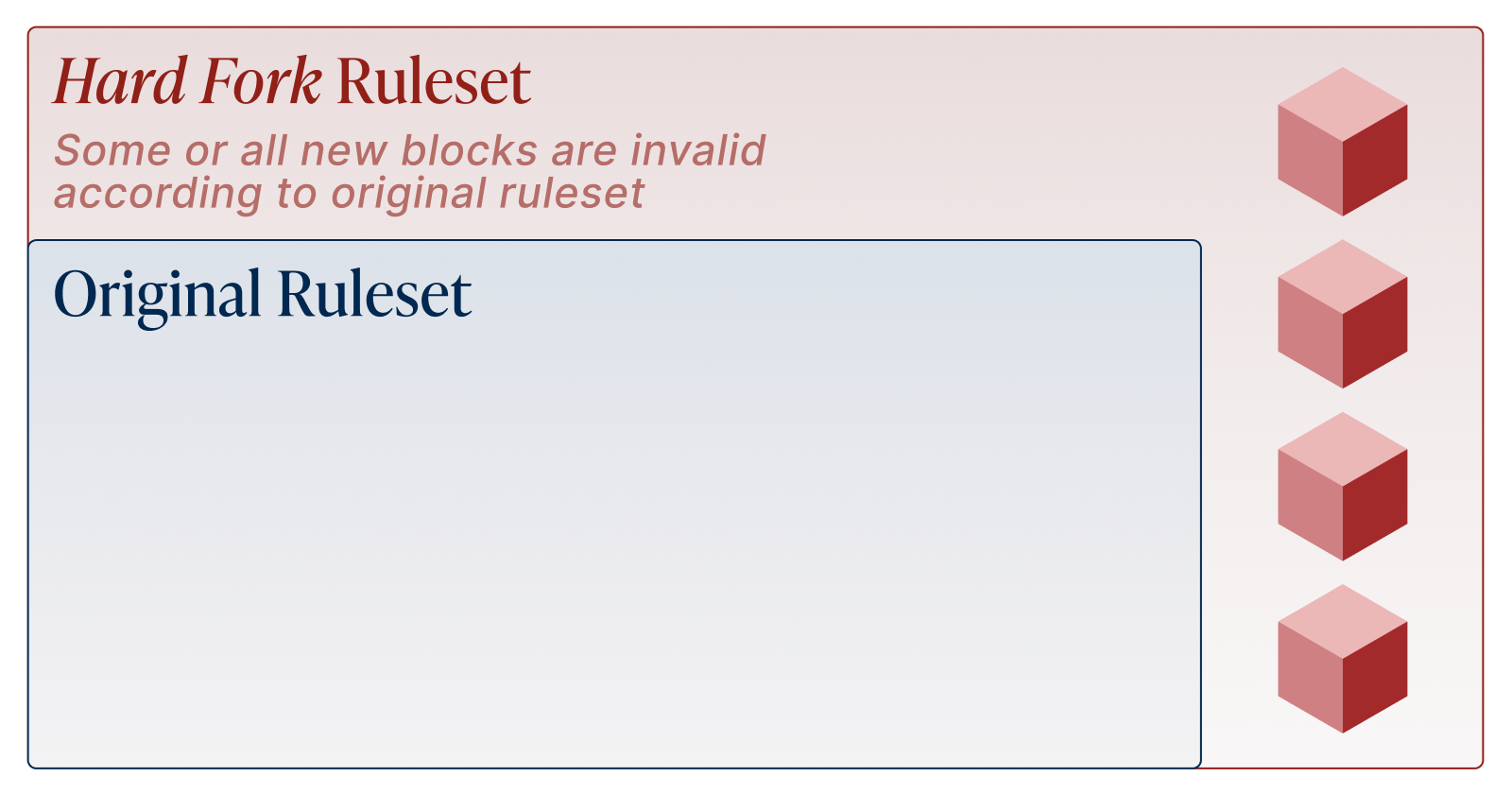
Hard forks are generally less desirable than soft forks, because of the backward compatibility issue that splits the network. Much was learned from the tumultuous “Blocksize War,” which occurred from 2015-2017. Some bitcoin users wanted to increase the blocksize limit, expanding the rules and creating a hard fork. They did so, splitting the network into the original Bitcoin network and a new network called Bitcoin Cash. Coins had different values on each network, so people had to decide which network to invest in, and miners had to decide which network to devote their energy (hashpower) toward. Because the economic consensus didn’t support the fork, Bitcoin Cash quickly lost market value and hashpower.
In our 2024 interview with Bitstein, president of the Satoshi Nakamoto Institute, he recalls:
“I stuck with what I think is the winning strategy with bitcoin, which is betting on the side of backwards compatibility because of what that represents for being able to engage with a monetary network. When you put your money away in savings, especially when you’re putting [something like] gold in a vault for generations to come, you need something that you know is going to be there. A hard fork basically creates a new currency. When you do that, you are not relying on proof-of-work anymore to have a true consensus around things. You’re introducing political variables, and that makes it less certain about what the future of that money is. [...] It’s a very rational thing to be wedded to backwards compatibility. [...] Once you hard fork, you’ve sort of opened Pandora’s Box, and to me it represents a slippery slope. You do that, and then three steps later it’s like, ‘Okay, now there’s no more 21 million.’ The things that hold bitcoin together as an operational system are very important, and to even give the possibility of them being put into jeopardy is extremely dangerous.”
This argument of conservatively safeguarding bitcoin’s fundamental restrictions is popular among many bitcoin users who reject the idea of a hard fork by default. The one obvious exception is if a hard fork is required for bitcoin to remain operational—in which case remaining with the original ruleset wouldn’t be a realistic option, and an upgrade is required regardless. This may be the case with the Unix timestamp overflow issue, which is expected to require a hard fork before the year 2106, unless a soft fork solution is discovered. Bitstein explains:
“This is a very special kind of hard fork because it is existential [...] because it’s existential, I have no choice but to choose it because I prefer bitcoin existing over not existing, more than I care about backwards compatibility.”
Activations and chain splits
Since bitcoin is open source code, anyone can create a fork at any time, simply by running a node and tweaking their software’s own ruleset surrounding the validity of transactions or blocks. However, such rule changes wouldn’t be automatically applied to the rest of the nodes on the network, because each noderunner controls what software they are using. By default, an individual who meaningfully adjusts their own ruleset is likely to find that their node is no longer fully interoperable with the rest of the bitcoin economy.
If you create your own soft fork by tightening your ruleset, bitcoin miners who haven’t followed suit will still validate new blocks following the broader rules, while your node might reject those blocks as invalid. Suddenly your node would no longer be following the canonical blockchain, but a different blockchain for which you’d have to mine your own blocks—this is known as a chain split. Similarly, if you create a hard fork to broaden your ruleset, any actions you take outside of the older ruleset will be rejected as invalid by the rest of the network that hasn’t followed suit. You would have to mine your own blocks with the expanded rules.
This shows why a consensus is needed for a fork to actually succeed in adjusting the ruleset across the dominant network. Careful coordination is important for activating a soft fork without a chain split, or a hard fork that retains the vast majority of economic activity.
Miner-activated soft forks (MASF)
A miner-activated soft fork is a relatively clean approach to deployment when there’s no real controversy surrounding the soft fork proposal. In a MASF, a window of time begins where miners can signal that they are prepared to switch to the tighter ruleset governing valid transactions and blocks. They signal their support by putting a data indicator in the blocks they add to the blockchain. If enough blocks are signalling within the time window, miners have expressed agreement to activate the soft fork at a particular block height. The length of the window and the signalling threshold are customizable (see BIP9, BIP8, BIP343).
For a MASF to succeed without a permanent chain split, it needs more than 50% of the global mining hashpower behind it. This is because nodes follow whichever valid blockchain is the longest (technically the “most-worked”). Any nodes that haven’t upgraded will accept blocks with the old ruleset as well as the new ruleset (because the new rules are a restriction, not an expansion). Therefore, if only a minority of hashpower is enforcing the soft fork, non-upgraded nodes will follow the blockchain governed by the old ruleset, because it would be seen as the longest valid blockchain. If a majority of mining hashpower is implementing the soft fork, the longest blockchain will eventually be the one that contains blocks with the new ruleset.
.png)
However, if the hashpower supporting the soft fork is only a slight majority, the miners that haven’t upgraded could get lucky and find blocks quickly, creating a longer chain and a temporary chain split. This chain split would last until the soft fork chain catches up and surpasses it, at which point there is a chain reorganization (also called a reorg) and all the blocks following the old ruleset would be discarded as invalid. This could have real financial consequences, because transactions thought to be confirmed and settled may not be. Reorgs are the reason why it’s recommended to wait for several block confirmations before considering a transaction final.
To avoid disruptions caused by large chain splits and reorgs, it’s better if the hashpower supporting a soft fork is not just a majority, but a supermajority. MASFs that have occurred so far in bitcoin’s history have used a cautious threshold of 95% or 90% of mined blocks signalling within the window. This way, if any block is mined according to the old ruleset after the soft fork, it is quickly replaced by a longer chain of blocks that follow the new ruleset. In practice, this also means that 100% of miners are incentivized to upgrade, so that they don’t spend resources mining blocks that quickly become rejected as invalid, thereby vaporizing their block reward revenue.
User-activated soft forks (UASF)
If the only way to activate a soft fork was with the MASF method, then miners would have the power to make or break any change, regardless of what other bitcoin users wanted. However, if noderunners want to implement a soft fork while miners are uncooperative, they can still do so with an economic consensus.
A user-activated soft fork is when noderunners coordinate an effort to simultaneously implement new software that restricts the ruleset that their nodes consider valid. There is no formal process for a UASF, but the idea would be to set a future date or block height at which all participating nodes begin enforcing the restriction. Nodes are also in constant communication with each other in the bitcoin network, giving noderunners the chance to signal whether or not they will be participating, and allowing the network to better gauge the overall support.
As we discussed in an earlier section, the raw count of nodes signalling support isn’t important, and can be manipulated. But if economically relevant nodes indicate that they will begin rejecting blocks that don’t follow the new rules, miners are put under pressure. Miners convert their energy expenditures into revenue by adding valid blocks to the blockchain, not blocks that are rejected as invalid by the economic consensus.
The best case study of UASF pressure was BIP148, which proposed a node-enforced activation of the Segwit soft fork if miners were noncompliant. This was during the 2015-2017 Blocksize War, when the community was divided. Eventually, miners did activate segwit via MASF before the BIP148 deadline. Bitcoin Optech recounts:
“The segwit soft fork was released with BIP9 activation parameters. A few miners quickly began signaling readiness but support peaked far below the 95% threshold. Some Bitcoin users felt miners were illegitimately delaying a useful new feature and went on to develop the mandatory activation that became BIP148. The final form of BIP148 specified rejecting any blocks that didn’t signal support for segwit starting on a certain date. [...] After BIP148 began receiving significant public support, several miners, exchanges, and other businesses signed their support for a two-step proposal that started with activation of segwit in a way that would remain in consensus with nodes supporting BIP148. [...] It remains a subject of debate exactly how much each of the above events, and other events occurring around the same time, actually contributed to segwit being activated.”
Hard fork activations
Much of the coordination involved with soft forks is to maintain backwards compatibility and mitigate chain splits. However, with a hard fork, it’s already known that a chain split will occur and that it won’t be backwards compatible. Due to the philosophy discussed in our earlier section introducing hard forks, we can differentiate two types of hard fork: one that is existential (bitcoin requires it to function) and one that is not.
In the case of an existential hard fork, the activation process likely depends on the issue that is threatening bitcoin’s existence, and whether it is anticipated or unexpected. In our 2024 interview, Bitstein explains:
“[With potential hard forks like the 2106 Unix timestamp issue,] we know we have time. Now, there’s another possibility where you have some break in the cryptography that happens tomorrow, in which case you don’t have time to prepare and you have to scramble. But this [Unix hard fork] especially, this is a great example of a good hard fork because of the fact that it’s deep in the future, so we have a long time to think about it. [...] The actual hard fork necessary is a rather simple one, I believe. [...] What I would expect to happen is people run two nodes, one with the old code and one with the new code—the small patch applied—and they sit and they wait, and when that moment comes, they watch and when one of them completely breaks, and when the other one is still going, everyone has a built-in Schelling point already around that new patch such that I think it would be successful without too many of the downsides we think of with regards to hard forks. That’s about the most conservative hard fork I can imagine.”
In the other case when a hard fork isn’t existential, it’s less likely to have consensus, due to the large cohort of bitcoin users that would reject the idea out of principle (this is less true for other cryptocurrencies that place less importance on decentralization). Still, a group of bitcoin users who feel differently could coordinate a date or block height at which they intend to simultaneously begin utilizing the expanded ruleset of the hard fork. Then, all noderunners and miners would have a choice to remain on the original network (the default) or switch to the hard fork network.
Splitting into two coins
A permanent chain split can be caused by a hard fork or by a community of noderunners and miners insisting on running a soft fork that fails to achieve economic consensus. These situations result in two different blockchains that share a history up until the fork, but after the fork they would each track different transactions occurring in their separate networks. This becomes colloquially recognized as two different “coins” with different names: the original Bitcoin, and a different name for the fork (such as “Bitcoin Cash”). If you had one coin before the fork, you would then have one coin of each type after the fork.
Concepts such as the network effect and liquidity preference create snowballing pressure toward one dominant chain, although a minority network can continue indefinitely.
“Consider the hypothetical example of an economy that uses exactly two currencies, Acoin and Bcoin, which are equally preferred by holders. For whatever reason, Acoin develops a very slight advantage over Bcoin. Consequently, a few people exchange Bcoin for Acoin, thus very slightly increasing the market cap and liquidity of Acoin and slightly decreasing that of Bcoin. Now, in addition to its initial slight advantage over Bcoin, Acoin has the advantage of becoming more liquid. As a result, more people will tend to sell Bcoin for Acoin. Thus, Acoin’s initial advantage is self-reinforcing, and as the disparity between Acoin and Bcoin increases, its superiority becomes more and more evident.”
— Daniel Krawisz article on SNI
Crucially, miners always need to decide which blockchain they will devote hashpower towards building, which will almost certainly be the one that is favored by the economic majority. Whichever blockchain ends up with the majority of hashpower is also more secure, furthering its advantage. A fork coin that ends up with a small minority of hashpower may even need an EDA (emergency difficulty adjustment) to continue to build new blocks, something that happened with Bitcoin Cash (though this initial fix caused its own instability and was later replaced).
Replay attacks
When the network permanently splits into two blockchains and two coins, it’s extremely important to understand replay attacks before transacting. If you held coins before the split, you will now have the same number of coins on both networks after the split. A replay attack occurs when you try to spend coins on just one of those networks, but someone copies your transaction over to the other network as well.
By default, at the time of the split, both networks share the same pre-fork UTXO set and signature requirements to spend coins. This means if you sign a transaction and broadcast it on Network A, the transaction and its signatures could be copied by anyone and broadcast on Network B as well, or vice versa. The recipient of the transaction won’t change, but you may not have intended to send coins from both networks to that recipient.
Consider the following hypothetical scenario: Alice has 5 bitcoin, and then a permanent chain split occurs, so Alice now has 5 “bitcoinFork” coins as well. Suppose bitcoinFork is much less popular than bitcoin, and is worth next to nothing, but someone named Mallory says she’s buying bitcoinFork for $100 per coin. Alice creates a transaction sending Mallory her 5 bitcoinFork, and happily receives $500 in return. However, Mallory takes the transaction data and broadcasts it on the real bitcoin network, too, which is accepted as valid. Therefore, Mallory also receives all 5 of Alice’s much more valuable bitcoin, at which point Mallory disappears. Alternatively, even if Mallory wasn’t a bad actor, someone else observing the network could execute the replay attack just to create chaos and confusion.
Replay protection
In preparation for a hard fork, the potential for replay attacks can be eliminated by introducing replay protection as a part of the hard fork. Replay protection slightly changes how transactions are validated on the new network. The safest implementation is strong two-way replay protection, so that transactions on either network aren’t valid on the other, and replay attacks aren’t possible. This was done for Bitcoin Cash. If a hard fork proposal intentionally lacks replay protection, it’s reasonable to view the proposal as hostile.
However, if a permanent chain split is caused by a soft fork, replay protection is less likely to be the default. A soft fork that includes replay protection as a part of the proposal could be interpreted as a sign of weakness, indicating that proponents don’t actually believe they will achieve economic consensus.
If replay protection isn’t built into the fork, there are other techniques that can guard against a replay attack. A user could create a series of transactions to separate coins in a way that is minimally vulnerable to a replay attack, or create a transaction that combines vulnerable inputs with invulnerable inputs (those unique to the intended blockchain). However, these techniques require knowledge and experience to execute properly, and shouldn’t be attempted by beginners.
How to protect yourself during a bitcoin fork
If a bitcoin fork is occurring or about to occur, you might be interested in a summary of what you need to know to protect yourself. In most cases, a reasonable course of action is to simply do nothing at all, which is great news for the significant population of bitcoin holders who aren’t paying close attention. However, the specifics are determined by the type of fork and its features.
Situations when you don’t need to take action:
- During a soft fork backed by economic consensus, which is the most commonly observed type of fork. If you want to utilize the new soft fork features, you would need to upgrade your node (or use an upgraded third-party node), but this is optional.
Situations when you don’t need to take action, and you should be very careful if you do:
- During a hard fork without economic consensus. This will result in a permanent chain split and two types of coins. You will have the same balance of coins on both the old network and the new, and you can passively observe which network becomes dominant. Activism (such as trading one type of coin for additional coins of the other type) is optional. If you decide to move coins of either type, first you should check if the hard fork includes built-in replay protection. It may be safest to avoid transactions until clear guidance is promoted by several trusted sources.
- During a soft fork without economic consensus. This could result in a permanent chain split and two types of coins. Active participation is once again optional, and if you decide to move coins of either type, you should be extremely careful and consider the possibility of replay attacks. It may be safest to avoid transactions until clear guidance is promoted by several trusted sources.
Situations when action is required:
- During a hard fork backed by economic consensus, which is expected to be very rare and likely only caused by an existential risk. In this case, the node you are using for economic activity will need to be upgraded, because non-upgraded nodes will no longer be useful. Other actions may need to be taken as well, depending on the specific issue. A situation like this would be so serious that the entire global community of bitcoin users would be discussing it and providing education. It would even be covered by mainstream news media, creating a scenario that is very unlikely to go unnoticed by bitcoin users.
Additionally, it’s important to be aware that scammers will try to take advantage of confusion during a bitcoin fork. For example, they may try to entice you by creating fake websites to “claim your forked coins.” They may engineer a sense of fear and urgency for you to move your bitcoin around in an unsafe way that allows them to steal your money. Don’t fall for it, and make sure you always follow our 11 rules for protecting yourself against scammers.
Unchained is here to help
At Unchained, a primary goal of our company is to provide services and education to help people navigate bitcoin self-custody in a secure manner. In particular, our Signature program provides you with access to a dedicated bitcoin expert for supporting your bitcoin-related questions and needs.
Unchained handles chain splits and forked coins according to our terms of service (section 26.12). It’s worth noting that Unchained is not a bitcoin custodian. Our self-custody multisig model gives you the opportunity to hold the controlling keys to your vault, import it into external wallet software of your choice, and connect to the bitcoin node of your choice outside of our platform. This gives you the freedom to use your bitcoin the way you see fit, even if we don’t provide direct support for certain activities. Please be careful when evaluating the use of external software, and always beware of scammers.
This article is educational only and has not been tailored to you or reviewed by any attorney, financial advisor, or tax professional; nothing in it may be relied upon as tax, legal, or financial advice. Unchained does not represent that the techniques, software, and/or hardware referenced by this article are appropriate for your given use case or legal in your given jurisdiction. For any questions related to your own specific situation, please consult with your own attorney, tax professional, and/or licensed financial advisor, and do your own research before using any specific technique, software, or hardware for purposes of storage or transmission of any bitcoin.
.png)
.png)