
Today, bitcoin’s 20 millionth coin was mined. We now live in a new era, where there will be less than 1 million bitcoin unlocked and released into circulation for the rest of time. Reflecting on this milestone, what’s particularly interesting is that it was predictable many years in advance. More than fifteen years ago, when bitcoin had barely begun to function, people could have confidently predicted that the 20 millionth coin would be mined in the year 2026. By contrast, if someone back in 2010 was trying to predict the supply of U.S. dollars, shares of a stock, real estate properties in an area, or even circulating physical gold that would exist in 2026, the estimates would have been much more vague and based on far more unpredictable variables.
This phenomenon is exactly what makes bitcoin the most reliable long-term asset. At first glance, bitcoin’s short-term price volatility can make it appear unreliable. But as soon as you begin to think on time horizons of decades and beyond, an honest investigation reveals that the supply of every non-bitcoin asset contains more uncertainty than bitcoin’s supply. We can’t be confident about how many dollars (or any other government currency) will exist 10 years from now. We also can’t be confident about how much physical gold we will have access to 10 years from now, especially as technology enables new extraction techniques. Even today’s current supply of dollars and gold are rough estimates that rely on trusting data from a small group of people. By contrast, anyone with a modern computer can independently verify the bitcoin supply in circulation today, and what it will be 10 years from now, 100 years from now, and thousands of years from now.
How bitcoin’s monetary policy is designed
Bitcoin’s supply is fixed at 21 million coins, but this supply was not released into circulation all at once. The inventor of bitcoin, Satoshi Nakamoto, chose a release schedule that sits between two opposite potential issues. First, if the supply was unlocked too quickly (such as immediately giving himself all 21 million) there would be a problem of distributing the coins to other people so that they could participate in the bitcoin economy. Second, if the supply was unlocked too gradually (such as 100k coins per year), then the scarcity of bitcoin would only begin to be felt decades or centuries in the future, and there would be less motivation to accumulate coins in the present. Why compete for coins now if the vast majority of coins would still be up for grabs many years down the road?
Satoshi’s middle ground solution was clever. Coins would be unlocked by anyone willing to expend energy to do the work (or “mining”) required to add new blocks to the blockchain. The distribution of coins would also be front-loaded, such that 50% of the entire supply would be unlocked in the first four years, then 25% in the following four years, then 12.5% in the four years after that, and so forth, until the fractions of the final 10 coins are slowly unlocked in the final 50 years of distribution. This model incentivizes people to acquire bitcoin sooner, when it is easier to do so. It also offers a certain degree of fairness, because from the very beginning anyone could, and still can, choose to participate in bitcoin mining, and everyone who chooses to do so must play by the same rules—even Satoshi himself was never an exception.
The distribution mechanism is simple. Whoever adds a block to the blockchain (thereby facilitating the settlement of bitcoin transactions) also gets to unlock a specific amount of bitcoin to keep for themselves. That amount is programmatically cut in half every 210,000 blocks, which works out to be about every four years. A block is added to the blockchain every 10 minutes on average, which is also programmatically enforced by a feature known as the difficulty adjustment, preventing the blockchain from growing too rapidly regardless of the amount of work done by miners.
These features are what allow anyone to calculate the future supply of bitcoin in advance. If we know how often blocks are added to the blockchain, and we know how much bitcoin can be unlocked by each new block, the math is trivial. The only reason we can’t be completely precise with predictions is because the time between blocks targets 10 minutes on average without being exactly 10 minutes.
Furthermore, these rules surrounding the monetary policy can reliably be expected never to change. Anyone who tries to change the rules would end up operating on a different network by themselves, unable to participate in the bitcoin economy that others have agreed to. For a proposed change to be effectively applied, it would have to be agreed upon by a consensus of bitcoin users. Since bitcoin holders are interested in what bitcoin uniquely offers—-long-term reliability—making any changes that would fundamentally change bitcoin’s monetary policy is extremely unlikely to achieve consensus support. We also now have historical evidence that this is true, because bitcoin has existed for nearly two decades in an adversarial environment pregnant with controversy, and yet the monetary policy remains the same as it was from day one.
Upcoming bitcoin milestones
Upon understanding how we can reliably predict the future supply of unlocked bitcoin, we can look ahead into the future to know when other interesting milestones will be reached. Then when they are reached, we can look back on our earlier predictions and appreciate just how reliable bitcoin is, in a way that all other assets have been unable to achieve.
The following is a select list of milestones, with an emphasis on occurrences in the next couple decades, but also including some larger ones in the more distant future.
If unlocking coins slows and stops, will mining continue?
A common question asked by people learning about bitcoin: once the supply of bitcoin becoming unlocked ceases to be significant, what will incentivize miners to keep investing in the work required to add blocks to the blockchain? The answer involves understanding that bitcoin miners don’t just get to keep the bitcoin they are unlocking, called the block subsidy, but also the transaction fees from all the transactions included in the new block. This feature will always be a part of the block reward, even after the block subsidy becomes irrelevant and eventually disappears.
The amount of transaction fees that can be earned in each block fluctuates. It’s difficult to know what the earnable fees will be in the distant future, and what those fees will be worth relative to the energy costs of mining the block. Some thinkers have suggested that the bitcoin network will be so popular in the future that fees will be prohibitively expensive for an average individual. Other thinkers have suggested the opposite, that payment layers used outside of the blockchain could mean that the fees available for miners to earn may be concerningly low.
The most prevalent view is that we will have to wait and see, rather than trying to change bitcoin to solve theoretical problems which are uncertain to manifest. If fees become “too high,” at the very least that implies institutions at the highest level will be benefiting from bitcoin as a reliable treasury asset and settlement network. If fees become “too low,” it’s possible that people or institutions seeking these benefits will mine bitcoin blocks at a loss, because they feel it’s a worthwhile tradeoff. Bitcoin miners in the present day also utilize excess energy that would otherwise be wasted, and it’s reasonable to think this will always be preferable to simply letting it go to waste.
Can other cryptocurrencies be as reliable as bitcoin?
In the sections above, we discussed why the rules that govern bitcoin’s fundamental monetary policy can reliably be expected to never change. Changes would require agreement from a consensus of users who appreciate bitcoin precisely because its monetary policy doesn’t change, creating a Catch-22. Additionally, the more users there are, the more room there is for dissent that prevents a consensus. This is what people mean when they refer to bitcoin being decentralized.
Every alternative cryptocurrency (or “altcoin”) has a smaller number of users than bitcoin. They all have smaller networks of nodes, less infrastructure, and ultimately less decentralization than bitcoin. This means that the bar is lower for what it would take to theoretically change the rules, and therefore they are unable to offer the same levels of reliability and predictability. Computer software can be replicated, but users and infrastructure cannot, which gives bitcoin a massive moat of protection. Bitcoin’s track record of consistency also can’t be superseded by an altcoin, because all altcoins were created after bitcoin.
Most altcoins don’t even try to compete with bitcoin when it comes to promising long-term reliability. The second largest cryptocurrency by market capitalization, Ethereum, has gone through substantial fundamental transformations and maintains a “roadmap” for further planned changes. The tokens have no fixed limit, inviting potential for future supply inflation. In the most charitable view, altcoins may be comparable to stocks in the stock market. Bitcoin stands separately as a simple yet reliable “digital gold.”
A unique asset like bitcoin deserves a unique security model
If you are interested in holding bitcoin to achieve the highest degree of long-term reliability, why would it make sense to secure your bitcoin with a model that is less reliable than another? Trusting a custodian (like a crypto exchange or an ETF) invites unnecessary risk. So does holding bitcoin in self-custody with a single key that could be lost or stolen.
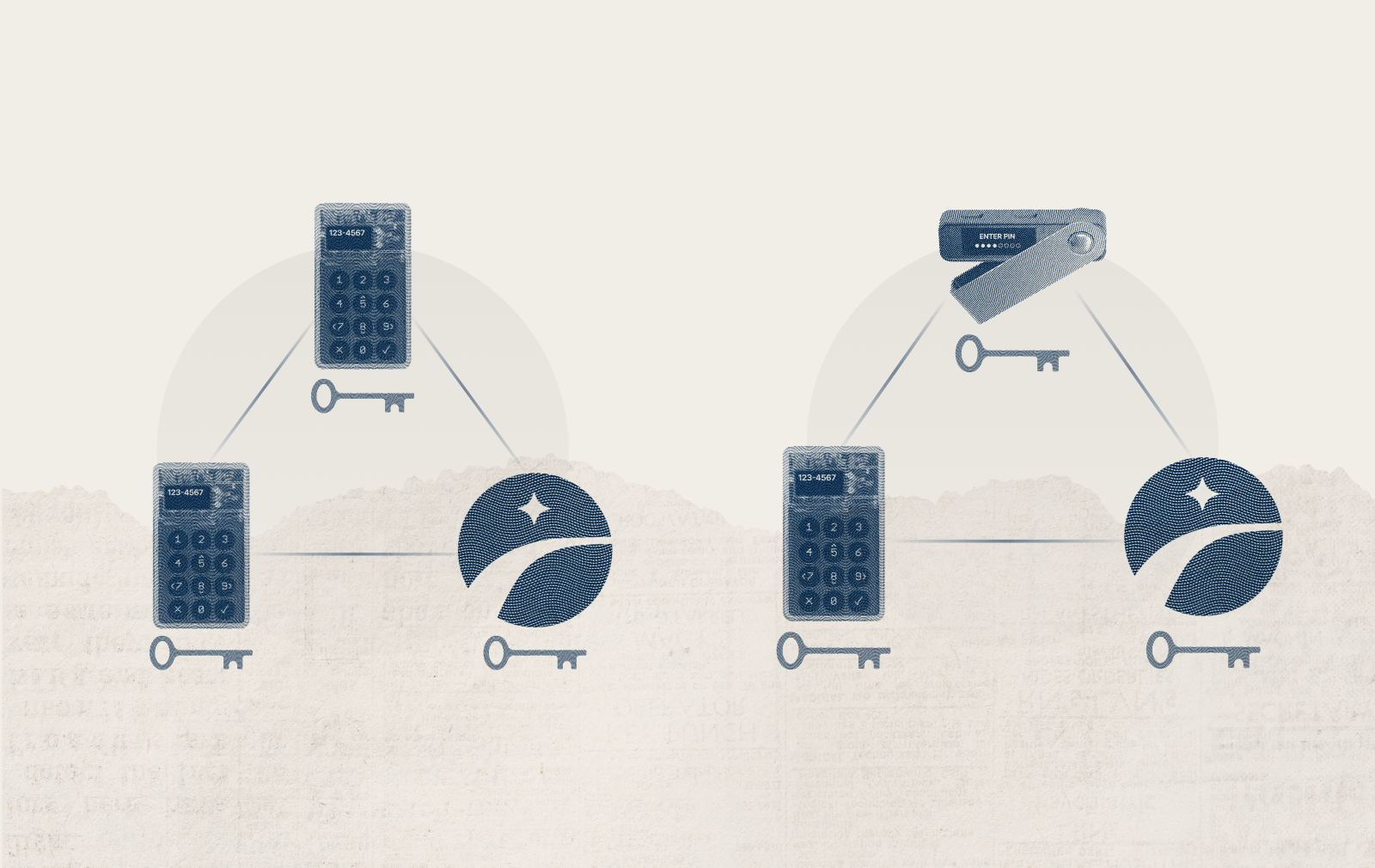
In our earlier article comparing the approaches to bitcoin self-custody, we demonstrate that multisig wallets, and specifically collaborative multisig wallets, have the best set of tradeoffs to succeed in securing bitcoin over decades and generations. If you have questions and want to learn more about whether this model is right for you, we invite you to schedule a free consultation call with the Unchained team. We specialize in this security model because we believe that reliability should never be compromised for bitcoin, the asset designed specifically for long-term reliability.
.png)
.png)
.png)